Planning a Canadian road trip? An Electric Car Rental can give you a quiet ride, lower energy costs, and a surprisingly easy driving experience if you plan your charging stops before you leave.
Key Highlights
- Canada had 38,364 public EV chargers in 2026, according to Transport Canada.
- Natural Resources Canada says EV range can fall by about 25% to 30% in extreme cold.
- Hertz currently lists Tesla Model 3 and Model Y among its Canadian EV rental options.
- Turo listings in Toronto show Tesla rentals ranging from roughly CA$68 to more than CA$200 per day, depending on the vehicle and listing.
- Public charging prices vary by network, province, charger speed, parking rules, and idle fees.
- For winter travel, you should choose your rental based on usable range, charging access, tires, AWD needs, and your route, not just the advertised range.
Electric Car Rental in Canada: Everything You Need to Know
Canada’s EV market continues to grow in 2026, making electric vehicles an increasingly practical option for renters. Statistics Canada reported that 43,113 new zero-emission vehicles (ZEVs) were registered in the first quarter of 2026, representing 10.8% of all new motor vehicle registrations and a 15.8% increase compared with Q1 2025. Battery-electric vehicle registrations rose 12.9% year over year, while plug-in hybrid registrations increased by 22.9%.
More recent sales data also show continued growth. In May 2026, 18,308 new ZEVs were sold in Canada, up 19.7% compared with May 2025, with ZEVs accounting for 9.6% of total new vehicle sales. For travelers, this growing EV market means more electric models are becoming available, particularly in major Canadian cities. At the same time, access to charging stations is becoming an important part of planning an electric car rental trip.
Why Rent an Electric Vehicle in Canada?
An EV can make a city trip feel very different. You get instant torque, almost no engine noise, and smooth acceleration without the gear changes you feel in a traditional gasoline car. If you are staying somewhere with overnight charging, you can also start each morning with a useful battery top-up without visiting a fuel station.
Gas Savings & Environmental Benefits
Your biggest practical benefit is that electricity can cost less than gasoline for the same distance, although the exact saving depends on the vehicle, electricity price, charging network, and driving conditions. You also avoid tailpipe emissions while driving, which is one reason Canada continues investing in EV infrastructure.

The environmental benefit is not identical everywhere because electricity generation varies by province. Your rental decision should therefore focus on the whole trip rather than assuming every EV journey has the same environmental impact.
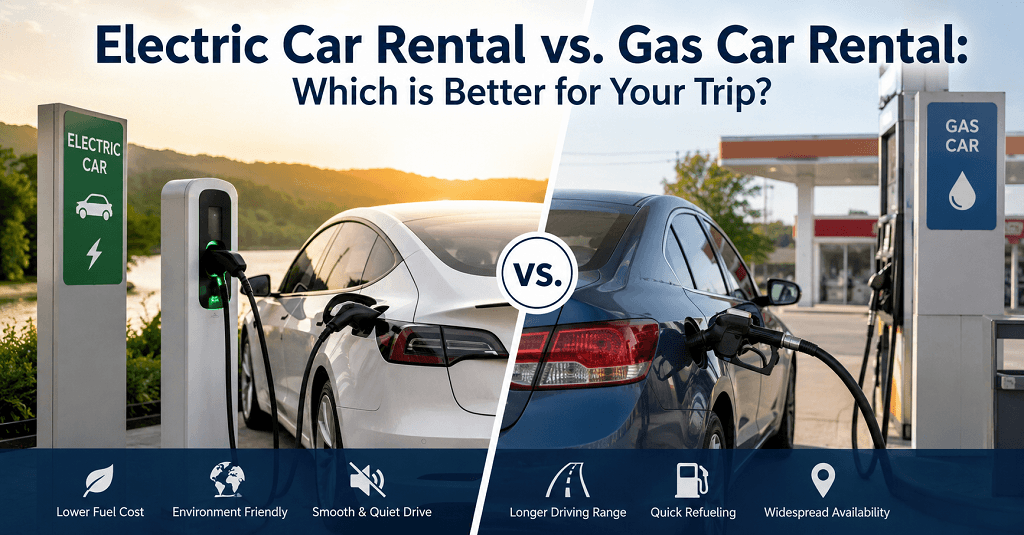
Electric Car Rental vs. Gas Car Rental: Which is Better for Your Trip?
| Factor | Electric Rental | Gas Rental |
| Refuelling | Charging required | Fast gasoline refuelling |
| City driving | Excellent | Good |
| Highway trips | Excellent with planning | Usually simpler |
| Winter planning | More important | Less complicated |
| Cabin noise | Very quiet | More engine noise |
| Energy cost | Often lower | Depends heavily on gas prices |
| Route planning | Charger planning recommended | Fuel stations are widely available |
| Best for | Cities, planned road trips | Remote routes and spontaneous travel |
How Does an Electric Car Rental Work in Canada?
Booking an EV is simple, but you should ask a few questions before paying. Confirm the exact vehicle, charging connector, included mileage, battery return policy, roadside assistance, and whether public charging costs are your responsibility.
You should also ask whether the rental includes a charging cable. Some vehicles rely heavily on public fast chargers, while others may be easier to use overnight at a hotel or private charging station.

Step-by-Step Booking & Pick-up Process
- Choose your city, dates, and rental company or marketplace.
- Select the EV category or specific EV model.
- Check the mileage and insurance terms.
- Confirm the charging and battery return rules.
- Ask about adapters and charging cables.
- Photograph the vehicle at pickup.
- Record the starting battery percentage.
- Learn the car’s charging port and navigation system.
- Plan your first charging stop before leaving.
This small checklist can prevent a lot of stress later. A five-minute conversation at pickup is much easier than discovering an unfamiliar charging connector beside a highway at night.
Return Rules: What Battery Level (SoC) Do You Need at Drop-off?
There is no single Canadian rule for EV return battery level. Your rental contract controls the requirement. Some companies may ask you to return the vehicle at approximately the same battery level, while others may use a charging fee if the battery is below the required level.
Always take a photo of the battery percentage when you collect and return the car. If the contract says 80%, don’t assume 60% is close enough. Battery return policies can affect your final bill.
What Are the Best Electric Cars to Rent in Canada?
The best rental EV depends on your trip. A small EV makes sense for city parking, an electric SUV is better for families and luggage, and a long-range model gives you more flexibility on highways.
| Rental Type | Models to Consider | Best Use |
| Compact | Chevrolet Bolt, Kia Niro EV | City trips |
| Family SUV | Tesla Model Y, Hyundai Ioniq 5, Ford Mustang Mach-E | Family travel |
| Long-range | Tesla Model 3 Long Range, Polestar 2 | Highway trips |
| Premium | Audi e-tron GT and similar models | Luxury travel |
1. Best Compact EVs for City Driving
Compact EVs are excellent when your trip includes downtown streets, parking garages, restaurants, hotels, and short daily drives. You don’t need a huge battery for city travel, and a smaller vehicle can be easier to park.
Chevrolet Bolt

The Chevrolet Bolt has long been popular as a practical EV because of its simple hatchback shape and useful everyday efficiency. However, availability as a rental varies considerably, so you should confirm the exact model and year before booking.
For a city holiday, focus less on maximum range and more on whether the rental location has convenient charging and whether the car has enough space for your luggage.
Kia Niro EV
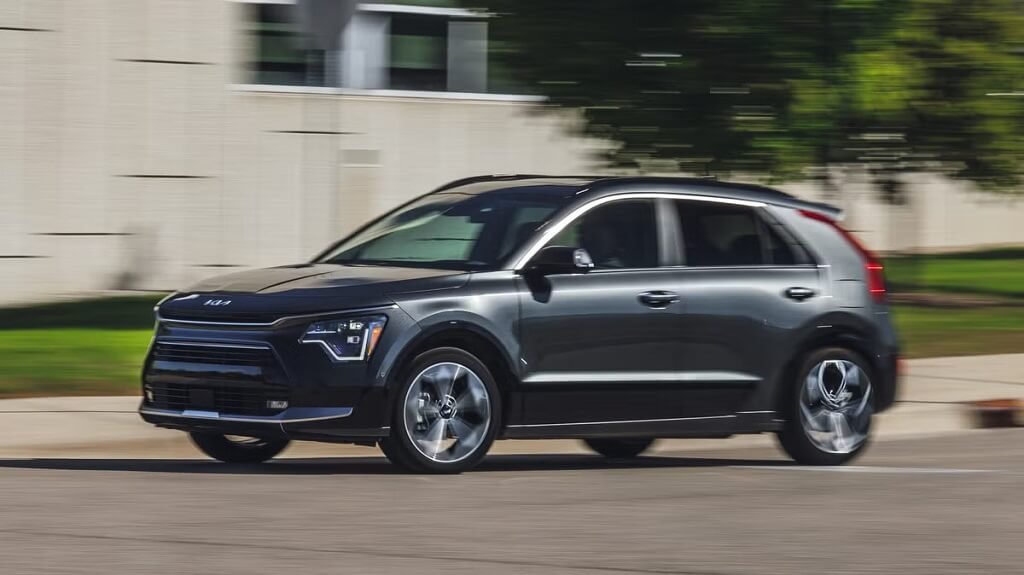
The Kia Niro EV is a useful middle ground between a small hatchback and a larger SUV. Kia Canada lists the Niro EV with up to 407 km of electric range, depending on configuration and testing conditions.
For couples or small families, it offers a practical balance of passenger space, cargo room, and range without feeling oversized in city traffic.
2. Best Electric SUVs for Families
An electric SUV is often the easiest choice when you have children, luggage, winter clothing, and several days of travel. You get more cargo room and a higher seating position, which many families prefer.
Tesla Model Y
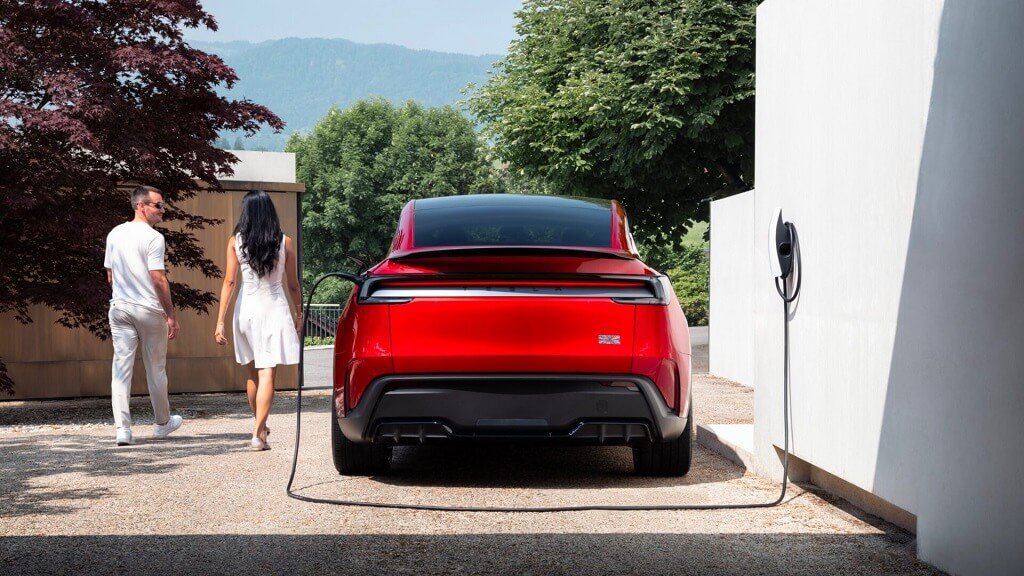
The Tesla Model Y is one of the most recognizable rental EVs in Canada. Hertz lists the Model Y in its Canadian EV fleet, with the company quoting up to 310 miles of range, or roughly 499 km, depending on configuration.
Its biggest rental advantage is familiarity. The navigation system integrates charging into trip planning, which can make your first EV road trip easier.
Hyundai Ioniq 5
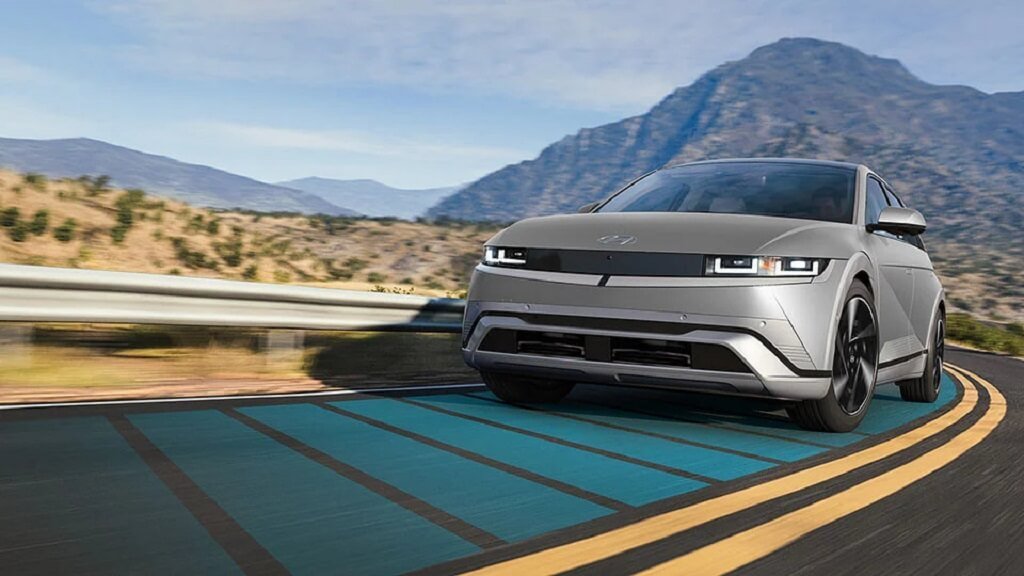
The Ioniq 5 is a strong option when comfort and fast charging matter. Its roomy cabin and flat floor make it family-friendly, while its fast-charging capability can reduce highway stop times when the right charger is available.
Before booking, confirm the charging connector and adapter supplied with the vehicle because equipment can vary between rental fleets.
Ford Mustang Mach-E

The 2026 Ford Mustang Mach-E offers estimated Canadian range figures from 380 km to 515 km, depending on battery, drivetrain, and trim.
That makes it an interesting choice for a family road trip. If you are travelling in winter, choose the longer-range version when possible because extra battery capacity gives you a larger safety buffer.
3. Best Long-Range EVs for Canadian Road Trips
For a road trip, don’t shop by advertised range alone. Look at charging speed, charging network coverage, battery size, winter performance, and the distance between stations on your actual route.
1. Tesla Model 3 Long Range
The Model 3 is especially useful for renters who want a smaller car with strong highway efficiency. Hertz currently offers Model 3 rentals in Canada, making it one of the easier EV models to find through a traditional rental company.
Its main advantage for road trips is the combination of efficiency and access to Tesla’s charging ecosystem.
2. Polestar 2
The Polestar 2 Long Range Dual Motor is rated for up to 447 km in Canada and supports DC charging of up to 205 kW, according to Polestar Canada.
It is a strong choice if you value a comfortable interior and confident highway driving. Rental availability, however, is more limited than for Tesla models.
EV Range: How Many Kilometres Can a Rental EV Actually Drive?
The number printed on the vehicle’s specification sheet is not a promise of how far you’ll travel on your rental. Speed, wind, temperature, hills, passengers, luggage, tires, heating, air conditioning, and battery condition all affect consumption.
Natural Resources Canada says the average EV can travel up to 450 km on one charge, while extreme cold can reduce range by about 25% to 30%. For a rental, build your plan around a comfortable buffer instead of driving until the battery is almost empty.
Real-World EV Range
- Official numbers aren’t guaranteed: Actual range depends on speed, weather, terrain, passenger weight, and A/C or heater usage.
- Average Range: Typically up to 450 km, but extreme cold reduces this by 25% to 30%.
- Play it safe: Never drive until the battery is empty; always keep a comfortable charging buffer.
Vehicle Types & Efficiency
- Compact vs. Luxury: Compact EVs are highly efficient in city traffic, while large luxury EVs consume more energy at highway speeds.
- Long-Range EVs: Having “long range” just means the car has a larger battery or a highly efficient powertrain.
- Route Planning: Plan your first charging stop well before the battery runs low, keeping the distance between chargers in mind.
Winter Driving Impact
- Major Range Drop: At -18°C, EV range drops by an average of 29%.
- Real-world reality check: In severe winter conditions (wind/snow at -18°C), a Tesla Model 3 used 80% of its battery for just a 183 km trip.
- Pro-Tip: Always “precondition” (warm up) the car’s cabin while it is still plugged into the charger to save battery life for actual driving.
Electric Car Rental Charging in Canada: The Complete Guide
Charging sounds complicated until you actually do it. Think of it like choosing a fuel station, except you have three main speeds and the car can often charge while you eat, shop, sleep, or work.
Canada’s public charging network has expanded quickly. Transport Canada reports 38,364 total chargers in 2025, up from 32,298 in 2024.
Charging Speeds Explained: Level 2 vs. DC Fast Charging (DCFC)
Level 2 charging is slower and is best when you have time. Hotels, workplaces, parking areas, and shopping centres often use this type of charger. DC fast charging is designed for road trips. Depending on the vehicle and charger, it can add a large amount of range during a meal or short rest stop.
Don’t judge charging only by the charger number. Your vehicle has its own maximum charging speed, and charging slows as the battery gets fuller.
Top Canadian Charging Networks
1. FLO
FLO operates charging infrastructure across Canada and provides different pricing structures depending on station ownership and region. Its published recommended rates vary by province and billing method.
2. The Electric Circuit
The Electric Circuit is especially important in Quebec. If you’re travelling through Montreal, Quebec City, or other parts of the province, check the network’s current station availability and pricing before you start driving.
3. Tesla Supercharger
Tesla Superchargers are particularly useful for Tesla rentals. The best part is route integration, because compatible Tesla vehicles can use the in-car navigation to plan charging stops.
4. BC Hydro
BC Hydro operates public EV chargers across British Columbia. From April 1, 2026, its listed rate is $0.3083 per kWh for Level 2 and $0.3969 per kWh for fast charging, before tax. Fast chargers also have a $0.40 per minute idle fee after five minutes.
Best Apps to Locate EV Charging Stations Across Canada
PlugShare is useful when you want community reports, station details, photos, and recent user comments. ChargePoint is another useful app for locating compatible chargers and managing charging sessions.
Before leaving, download the apps you need and create your account. You don’t want to stand outside in freezing weather trying to create a password while your rental sits at 8%.
How Much Does an Electric Car Rental in Canada Cost?
Rental prices change with city, season, vehicle age, demand, rental length, insurance, mileage limits, and pickup location. Current listings give a useful snapshot rather than a fixed national price.
For example, Turo’s Toronto EV listings recently showed a 2021 Tesla Model Y at around CA$68 per day for a three-day trip, while other Tesla and luxury EV listings were considerably higher. Hertz also currently lists Tesla EVs in Canada, and individual locations can show different rates.
Traditional Rental Agencies vs. Turo
| Option | Main Advantage | Main Concern |
| Hertz | Established rental process | Vehicle choice may vary |
| Avis | Traditional rental support | EV inventory differs by city |
| Enterprise | Familiar rental structure | EV selection can be location-specific |
| Turo | Large variety of individual EVs | Host rules vary |
| Peer-to-peer rental | Specific models may be easier to find | Pickup and policies differ |
Hidden Fees & Idle Charging Costs to Watch Out For
Your daily rental price is only one part of the bill. Check mileage charges, insurance, young-driver fees, airport fees, cleaning charges, toll administration, charging penalties, late-return fees, and battery return requirements.
Idle charging fees deserve special attention. BC Hydro, for example, charges $0.40 per minute after five minutes at its fast chargers once your vehicle has stopped charging.
The simple rule is to move the car as soon as charging finishes.
Where to Find an Electric Car Rental in Canada
Major airports and downtown areas are usually the best places to start your search. Toronto, Vancouver, Montreal, and Calgary have larger rental markets, so you have a better chance of finding multiple EV choices.
Search both traditional rental agencies and peer-to-peer marketplaces. Compare the total price, not just the advertised daily rate.
EV Rentals in Major Cities
Toronto
Toronto has a strong selection of EV rentals, especially Tesla models. Current Turo listings show several Model 3 and Model Y options with different prices and review histories.
Vancouver
Vancouver is another strong EV market. Hertz currently lists Tesla Model 3 rentals at its downtown Seymour Street location, although displayed prices can vary substantially by date and demand.
Montreal
Montreal is well suited to EV travel because Quebec has extensive charging infrastructure. If you plan to explore beyond the city, map your charging stops before leaving.
Calgary
Calgary is a good starting point for Alberta road trips, but distances can become much larger once you leave the urban area. For trips toward Banff or other mountain destinations, check elevation, weather, tire requirements, and charger availability.
Airport Pick-ups vs. Downtown Rental Locations
Airport pickup is convenient, especially after a long flight. The downside is that airport rentals can include extra location fees and may have different inventory.
Downtown pickup can sometimes be cheaper and may give you more flexibility. Compare the final checkout price before deciding.
| Factor | Airport Rental Location | Downtown Rental Location |
|---|---|---|
| Convenience | Very convenient after a flight | Better if you are already staying downtown |
| Rental Price | Often more expensive | Can be cheaper |
| Airport Fees | May include airport-related fees | Usually avoids airport facility fees |
| Travel Time | Pick up the car immediately after landing | Requires getting to the rental office |
| Public Transport | Usually easy to access | Often easy to reach from hotels |
| Best For | Travelers starting their trip outside the city | Travelers staying in the city first |
| Drop-off | Convenient when flying home | Convenient if your trip ends downtown |
| Vehicle Choice | Often a wider selection | Selection may be smaller |
Canada-US Cross-Border Electric Car Rental Rules
Cross-border travel needs extra attention. U.S. Customs and Border Protection says that a rented vehicle crossing into another country requires written authorization from the rental company.
Don’t assume that because you can drive your own car across the border, you can automatically take a rental EV into the United States. Ask the rental company before booking and confirm insurance, authorization, mileage, and roadside assistance rules.
Charging also needs planning because the same connector does not guarantee that every network or payment method will work seamlessly across the border.
Real Owner Reviews and Canadian EV Experiences
Real-world Canadian experiences are useful because they reveal problems that specification sheets don’t show. One Canadian EV owner reported driving more than 109,000 km over two years in extreme prairie conditions and said the Tesla Model 3 helped reduce fuel costs, while also highlighting the importance of charging infrastructure.
Another Canadian EV discussion reported that cold weather and strong wind can create much larger range losses than drivers expect. These reports should not replace official testing, but they are valuable reminders to leave a buffer in winter.
The strongest lesson from Canadian drivers is simple: charging access matters as much as battery size.
“ The electric rental was a great choice for our trip. We compared several EV options before booking and found a car that offered good range, comfort, and value for money. ”
– Perfect for a Canadian Road Trip
What Should You Check Before Booking an Electric Car Rental?
Use this quick inspection list before you confirm payment:
- Exact EV model: Don’t rely only on “electric SUV.”
- Real range: Check the specific battery and trim.
- Winter tires: Essential for many Canadian winter trips.
- Charging connector: Confirm what the car uses.
- Adapter: Ask whether one is included.
- Battery return level: Get the requirement in writing.
- Mileage: Check whether kilometres are unlimited.
- Insurance: Understand your coverage before pickup.
- Roadside assistance: Confirm who to call.
- Cross-border use: Get written permission if needed.
These details can turn an expensive surprise into a predictable rental.
Conclusion
An Electric Car Rental in Canada can be a smart choice when you plan around the vehicle instead of treating it exactly like a gas car. Pick the EV based on your route, keep a winter range buffer, use charging apps, and understand the rental company’s battery return rules before leaving the lot.
Canada’s charging network is expanding, and the federal Energy Fact Book reports about 39,000 public chargers in 2026. That makes EV road travel much easier than it was a few years ago. Still, remote routes and severe winter weather deserve extra planning.
If you’re renting your first EV, a simple city trip is a great place to start. Once you understand charging and range, you can confidently move on to longer Canadian road trips.
FAQs
Where can I charge an EV?
You can charge an EV at public Level 2 stations, DC fast chargers, hotels, shopping centres, workplaces and some homes. Canada’s public charging network includes roughly 39,000 chargers in 2026, according to the federal Energy Fact Book. Apps such as PlugShare and ChargePoint can help you locate stations and check useful information before you drive there.
How much does it cost to charge an EV?
There is no single Canadian charging price. Costs depend on the network, province, charger, billing method and location. FLO says station owners can set rates and that charging may be billed by the hour, session or, where permitted, by energy consumed. Tesla also uses location-specific pricing.
What distinguishes the driving behavior of an electric car?
An EV feels different because the electric motor delivers torque immediately. Acceleration can feel smooth and quick, while regenerative braking can slow the car when you lift off the accelerator. You also need to pay more attention to battery percentage and charging stops than you would with a gasoline car.
Which is the cheapest EV car in Canada?
The cheapest EV changes with model year, promotions, inventory and incentives. The federal EVAP vehicle list includes eligible lower-priced models, but the program uses the final transaction value rather than simply the advertised starting MSRP. Always check the current Canadian market price before deciding which model is cheapest.
Are EV charging stations free in Canada?
Some charging stations are free, but many charge a fee. Free charging may be offered as a customer benefit by a hotel, shopping centre, workplace or other property owner. FLO notes that station owners set charging rates, so check the station’s current pricing before plugging in.
Who is eligible for the Canada EV rebate in 2026?
The federal Electric Vehicle Affordability Program applies to eligible new EV purchases or leases. For 2026, qualifying battery-electric and fuel-cell vehicles can receive up to $5,000, while qualifying plug-in hybrids can receive up to $2,500. The program generally requires a final transaction value of $50,000 or less, although Canadian-made EVs have no transaction value cap. Individuals can receive one incentive over the five-year program.
How expensive is renting a car in Canada?
Rental prices vary widely by city, season, vehicle and rental company. Current EV listings show examples ranging from roughly CA$56 per day to more than CA$200 per day, while Hertz location pages can show much lower or higher rates depending on date and branch. Treat online prices as snapshots and compare the final checkout amount before booking.